
Among all Chinese ceramics, few are as legendary and visually captivating as Jun Kiln (钧窑). Famous for its dramatic “kiln change” (窑变, yáobiàn), Jun porcelain seems almost alive — its glazes shifting in color and depth depending on light, angle, and time. Jun Kiln is not just beautiful teaware. It is one of the highest expressions of Chinese ceramic art and a profound expression of the philosophy that beauty can arise from surrender to nature.
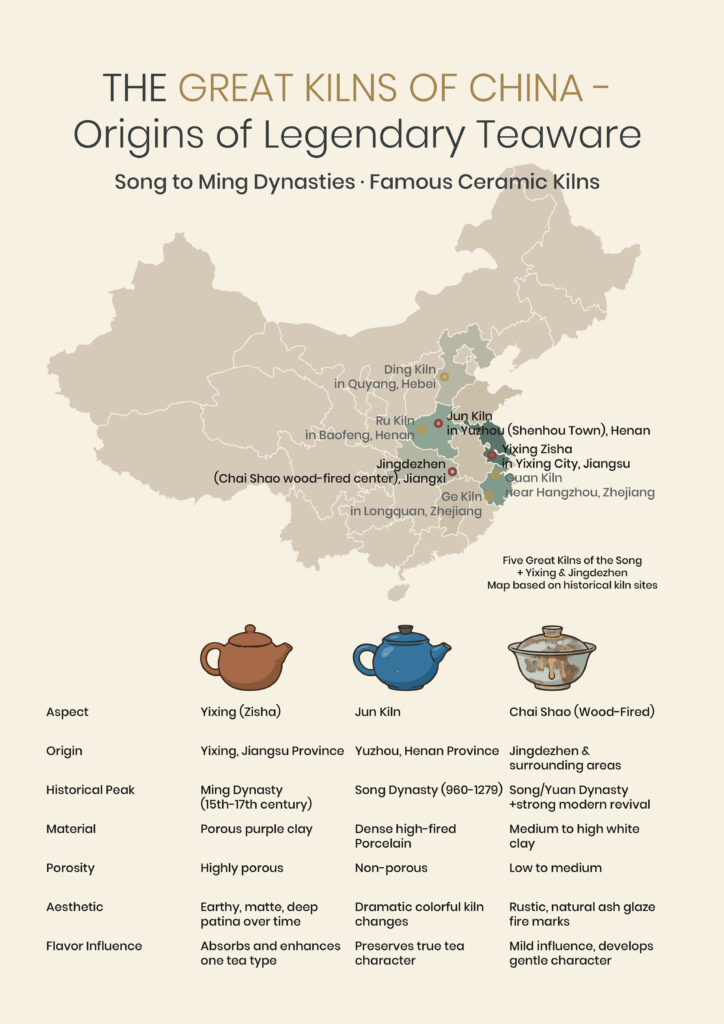
During the Song Dynasty (960–1279), Chinese ceramics reached their artistic peak. The emperors, scholars, and literati of this era celebrated five legendary kilns, known as the Five Great Kilns (五大名窑):
While the other four kilns are admired for their restraint, elegance, and technical control, Jun Kiln stands out for its bold, expressive beauty and its almost magical transformation in the kiln. It is often called the “most colorful of the Five Great Kilns.” Song aesthetics valued both quiet refinement and the natural, spontaneous beauty of materials. Jun Kiln embodied the second ideal most purely.
Jun Kiln originated in the late Tang and Five Dynasties period and reached its height during the Northern Song Dynasty in Yuzhou, Henan Province. The kilns were located near the ancient capital of Kaifeng and supplied the imperial court. The famous “Jun red” and the flowing, multi-colored glazes became highly prized.
Unlike many other Song kilns that later declined, Jun Kiln never completely disappeared. After the Song Dynasty it continued in smaller scale through the Yuan and Ming periods, though its imperial status faded. In the 20th and 21st centuries, a revival took place. Masters such as Wen Hongyuan from Yuzhou have become leading figures in restoring and elevating the art. Several of his works are now in the collection of the National Museum of China.
What makes Jun porcelain so special is the 窑变 (yáobiàn) — the kiln transformation. The process is both technical and deeply philosophical.
The glaze is made from a carefully balanced mixture of local clays, plant ash, and metal oxides (especially copper and iron). During the high-temperature firing (often above 1300 °C), the atmosphere inside the kiln — whether oxidizing or reducing — interacts with these oxides in ways that cannot be fully predicted. Copper, in particular, can produce reds, purples, and turquoise depending on the amount of oxygen present at critical moments.
The result is flowing rivers of color — deep reds, purples, blues, turquoise, lavender, and milky whites — that appear to move across the surface. No two pieces are the same, even when fired in the same kiln at the same time. The potter prepares the clay and glaze with great care, then must let go. The final beauty is co-created by fire, chemistry, and chance.
This acceptance of unpredictability is central to the ceramic philosophy of Jun Kiln. It reflects a Daoist-influenced view: the highest skill lies not only in control, but in knowing when to surrender to natural forces.
Unlike highly porous Yixing clay, Jun Kiln porcelain is dense and non-porous. This means:
Best suited for:
It is less ideal for heavily fermented Shou Pu-erh or very dark, aged teas, where a more porous clay like Yixing is often preferred.
Jun porcelain is relatively easy to maintain:
Because the glaze is hard and non-porous, it does not require the same careful “seasoning” as Yixing clay.
Jun Kiln teapots are more than functional vessels — they are miniature works of art born from fire, chemistry, and the willingness to accept the unexpected. In a world full of mass-produced objects, they remind us that true beauty often lies in the unpredictable, the imperfect, and the deeply human connection between earth, fire, and time.
To hold a Jun Kiln teapot is to hold a small piece of Song Dynasty poetry — and a quiet lesson in letting go — in your hands.
–> Jun Kiln vs Chai Shao vs Yixing > Blog
–> Yixing > Blog



Chat with us